Forgiving oneself can be one of the most challenging aspects of personal growth.
It is a tough practice because it reminds us that we are not perfect. We are prone to making mistakes, and sometimes, our thoughts and actions can prove costly.
Heaven knows we need these sober experiences to check against Hubris and self-conceit. More importantly, for us to be gracious to ourselves and everyone else around us, emulating God’s gracious and loving heart towards Mankind.
But all these are forestalled if an individual is unaware that they need to forgive themself or if they have limiting beliefs about the concept and practice of self-forgiveness. The resulting consequence is toxic perfectionism, personal stagnation, self-hate, and internal dissonance.
In this article, we will briefly discuss what self-forgiveness is and highlight several signs and tests to show if you need to forgive yourself for some wrong or past offense.
Understanding the Foundation of Self-Forgiveness
Self-forgiveness is simply an act of grace towards oneself. It involves recognizing the harm caused by our actions (or inactions), acknowledging our responsibility, and then taking deliberate steps to reconcile our thoughts, dispositions, and actions with true values.
This process is not about excusing our behavior but about learning from our mistakes and releasing the burden of guilt that can hold us back.
How we handle these situations makes or mars our lives. On the negative front, unresolved guilt can paralyze us and prevent growth. But on the positive note, it can spotlight shortcomings that we could work on as we strive towards the best version of ourselves.
No nobler course than a man who—in spite of setbacks—remains committed to becoming all that he was made to be in design and purpose.
Achinike Amadi
How to Know When You Need Self-Forgiveness: Clear Signs You Need to Forgive Yourself
Recognizing when you need self-forgiveness is crucial for your emotional and spiritual health. Here are the key indicators:
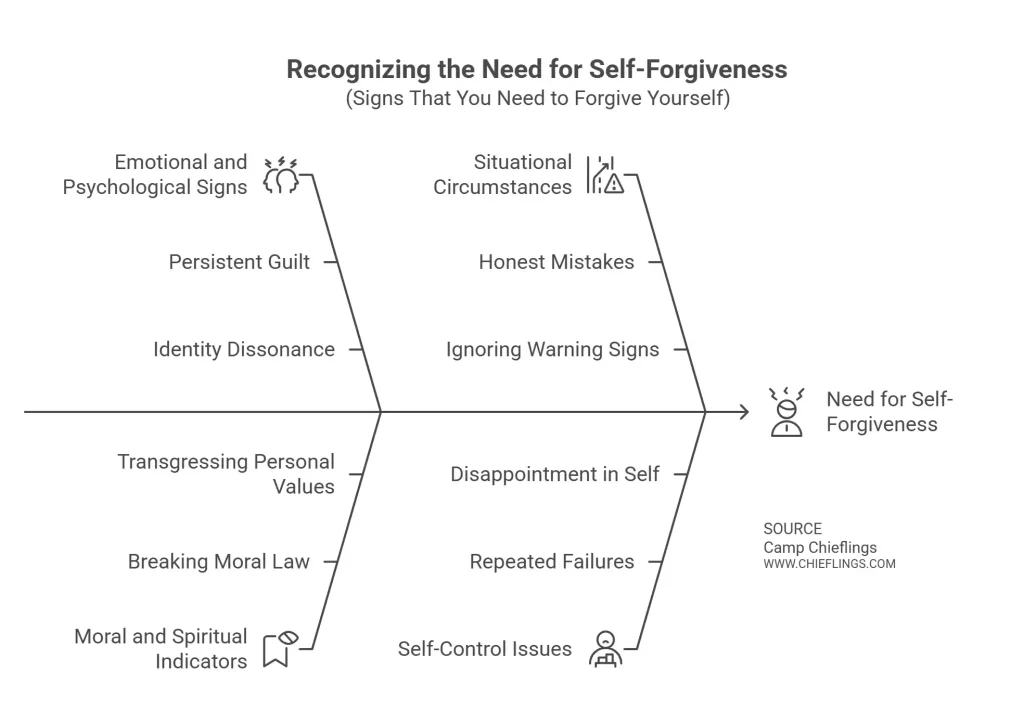
Emotional and Psychological Signs
- You feel guilty for a wrong action you took: This persistent guilt gnaws at your peace and affects your daily functioning.
- You blame yourself for a negative outcome, whether based on objective truth or subjective perception. Sometimes we carry responsibility that isn’t entirely ours to bear.
- You experience identity dissonance—an incongruence between your true values and your actions. This internal conflict creates deep psychological distress.
- You feel stuck and are limiting your true potential. Unresolved guilt holds you back from making forward progress and impact, creating an invisible prison of self-limitation.
Moral and Spiritual Indicators
5. You broke the moral law. You did something you swore never to do, violating your own ethical standards.
6. You did something the Bible clearly instructs against. Examples include cheating on your partner, excessive drinking, or any form of abuse.
7. You hurt someone through your words or actions, causing pain that weighs heavily on your conscience.
8. You transgressed against your personal values or principles that define who you are at your core.
Situational Circumstances
9. You made an honest mistake. Even unintentional errors can require self-forgiveness, especially when they have significant consequences.
10. Someone let you down, hurt you, or disappointed you, and somehow you feel you could have done better to prevent it. This misplaced responsibility often requires self-compassion.
11. You saw all the signs of trouble but ignored or excused them, only for the situation to come back and cause harm. The regret of not acting on your intuition can be overwhelming.
12. You’re struggling with self-control issues that have led to repeated failures and disappointment in yourself.
The Bible addresses this human condition in 1 John 1:9:
“If we confess our sins, he is faithful and just and will forgive us our sins and purify us from all unrighteousness.”
This verse reminds us that when we confess our sins to God, He forgives us completely. If God, who created and loved us, has forgiven you, then you have no reason not to do the same for yourself.
People Groups Who Especially Need Self-Forgiveness
Self-Forgiveness for New Converts
Forgiving yourself is an essential early step every new convert will take on the Christian journey. Yet for most, it is a real struggle because of the memory and shame of all the evil things we did when we were in the world, being ruled by our carnal desires.
It is easy to hate ourselves for those actions. It is more difficult to let it go. But the beautiful thing is that in salvation itself, there is great enabling grace for self-forgiveness made available to us. The question is: would you use it?
2 Corinthians 5:17 tells us: “Therefore, if anyone is in Christ, the new creation has come: The old has gone, the new is here!” This transformation is not just spiritual—it’s also psychological and emotional.
Crystallize Your Learning
Curated For You: 38 Comprehensive Verses about Forgiveness in the Bible
Self-Forgiveness for Leaders
Every leader has responsibilities placed on their shoulders. Problems arise in a variety of shapes, forms, and sizes, and leaders are expected to rise to the challenge every time. These are heavy burdens to carry. Please try not to add the burden of guilt or self-directed resentment for flaws to it.
I would be the first to admit: I am not always sure of everything I do.
I get some things wrong. My decisions are not always the wisest, and in extremely challenging situations, I could cave in to my weaknesses and lose grasp of my emotional and intellectual capabilities.
But I try to come correct and take the high road.
All leaders must practice self-forgiveness to reach their peak potential. Show me a high achiever, and I will show you a leader who forgives themselves.
Take King David of the Bible, for instance. After he had sinned by orchestrating Uriah’s death and taking Bathsheba as his wife, Prophet Nathan came to him with a parable. David understood the standard and the moral thing to do, but somehow failed to see how it applied to his actions. Soon after evaluating his actions in light of the moral law, he realized his sin, confessed, and repented, going on a fast. After the child died, he moved on. He forgave himself.
David’s response shows us the complexity of self-forgiveness. In Psalm 51:10, David prayed: “Create in me a pure heart, O God, and renew a steadfast spirit within me.” This wasn’t just about asking for forgiveness—it was about internal transformation and moving forward.
Self-Forgiveness for Maturing Christians
“Only those of little faith struggle with sin. The highly spiritual ones do not struggle with sin” is a myth.
I tell you, sin remains a daily battle for anyone inhabiting this fallen flesh and world. For mature Christians, the personal offense can be more adverse, considering that they have gained a solid foundation in the Word and precepts of God, and still didn’t make informed decisions.
You might be thinking, “I should know better. I have the Holy Spirit. I ought to have outgrown this kind of mistake. Am I totally helpless?”
Beat yourself up no more. Understand this: When the Holy Spirit came into your life, He didn’t come into a clean, tidy, and holy heart. He came to consecrate your heart to God. He makes you holy—not your actions or thoughts.
The Bible reinforces this truth in Romans 8:1:
“Therefore, there is now no condemnation for those who are in Christ Jesus.”
This powerful verse reminds us that in Christ, there is no condemnation, and it has been made final. Christ has done a perfect work. It was enough when you got saved; it is more than enough to carry you through the journey.
The Path Forward: Practical Steps to Self-Forgiveness
The journey to self-forgiveness begins with honest recognition and complete ownership.
First, acknowledge the standard you’ve fallen short of—whether it’s God’s law, your personal values, or societal expectations—without making excuses or deflecting blame. This requires taking full responsibility for your actions and their consequences, refusing to minimize your role or rationalize your choices away.
We have documented and published a more extensive and detailed guide in another blog post. Find more instructive and practical steps to self-forgiveness here.
Curated For You: How to Forgive Yourself: 9 Action-Steps to Inner Peace.
Final Words: The Transformative Power of Self-Forgiveness
As pointed out earlier, Self-forgiveness isn’t about excusing sin or lowering standards. It’s about accepting God’s grace and extending it to yourself.
It’s about recognizing that while you are responsible for your choices, you are not defined by your worst moments.
When we practice healthy self-forgiveness, we:
- Break free from the cycle of shame and self-condemnation
- Open ourselves to growth and positive change
- Model grace and mercy to others
- Align ourselves with God’s heart toward us
- Unlock our potential for future impact
The journey of self-forgiveness is not always easy, but it is necessary for anyone who wants to live in freedom and reach their God-given potential.
Take the high road. Forgive yourself and step boldly into the person you were created to be. The time is now.